Content
Zhenghong Tang
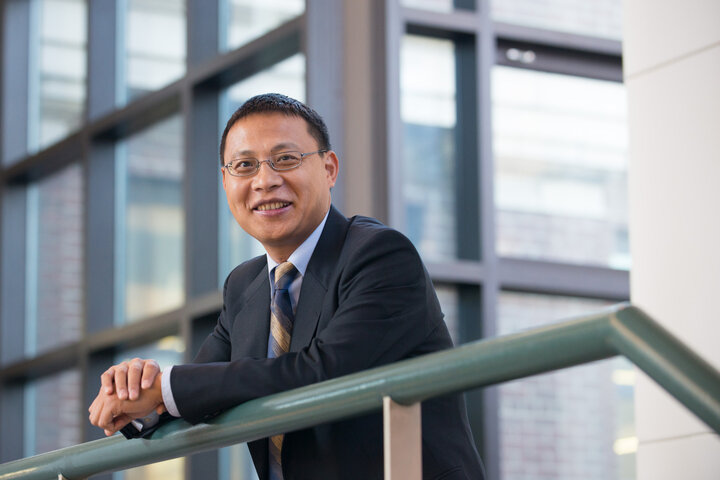
Dr. Zhenghong Tang is a Professor in the Community and Regional Planning Program within the College of Architecture at the University of Nebraska–Lincoln. He served as Program Director for Community and Regional Planning from 2020 to 2024 and currently serves as the Associate Dean for Research and Innovation in the College of Architecture. Dr.Tang also serves as a professor in the Landscape Architecture Program at the University of Nebraska-Lincoln. He also holds a courtesy professor in the School of Natural Resources and the School of Global Integrative Studies, and serves as a faculty fellow in the Daugherty Water for Food Global Institute and the Center for Great Plains Studies. Dr. Tang received the American Planning Association (APA) Nebraska Chapter President’s Award in 2025, was featured on the Stanford/Elsevier World’s Top 2% Scientists List in 2024, and received the Chester Rapkin Award from the Association of Collegiate Schools of Planning (ACSP) in 2019.
Dr. Tang teaches undergraduate and graduate courses in various subjects including CRPL 470/870 Environmental Planning and Policy, CRPL 433/833 GIS in Environmental Design and Planning, CRPL 471/871 Environmental Impact Assessment, CRPL 472/872 Hazard Mitigation Planning, CRPL 802 Planning Theory, and CRPL 990 Planning Studio.
Dr. Tang's research agenda encompasses the below major research areas:
(1) Promoting “integrated planning” approach to improve state and local planning capacity for community resilience and sustainable development: Dr. Tang's research focuses on advancing an "integrated planning" approach to strengthen the capacity of state and local agencies in addressing extreme hazards, enhancing community resilience, and promoting sustainable development. This approach emphasizes the importance of tackling long-term, complex, and strategic environmental challenges, such as droughts and floods, through coordinated and adaptive planning. Dr. Tang collaborates extensively with state and local planning agencies, advocating for adaptation practices that support sustainable community development. He has participated in local, regional, and state level's wetland conservation planning, flood mitigation planning, and watershed planning.
(2) Developing Geo-AI tools to advance environmental monitoring and assessment in agricultural and urban landscape: Dr. Tang's current research focuses on developing geospatial information platforms that leverage machine learning, deep learning algorithms, and artificial intelligence (Geo-AI) for conservation mapping and environmental decision-making. These near-real-time platforms provide high-resolution, advanced insights into ecosystem services at spatiotemporal scales. This information supports federal, state, regional, and local agencies in wetland restoration, watershed planning, and soil and water conservation, offering valuable scientific assistance to guide effective environmental management.
(3) Supporting Economic Development through Regional Solutions on Natural and Cultural Assets and Emerging AI Opportunities: Dr. Tang’s research focuses on integrating local natural, cultural, historic, and tourism assets at the regional scale to foster sustainable economic development—particularly in rural communities. His recent research has supported downtown revitalization and economic development planning efforts for several Nebraska communities, including Elmwood (2025), Ogallala (2024), Bennet (2023), Peru (2023), Beatrice (2022), Syracuse (2020), and David City (2020). In addition, he has contributed to affordable housing policy initiatives in York County and Lincoln/Lancaster County, as well as a regional tourism development plan for the Ponca Tribe, the City of Niobrara, and Knox County, Nebraska. In recent years, his work has expanded to explore how the natural and built environments can actively support and enhance the rapid development of artificial intelligence (AI). His research examines how sustainable land use, resilient infrastructure, and resource-efficient systems—such as water and energy networks—can form a strong foundation for AI innovation. By integrating spatial planning and environmental design, this research seeks to create synergistic relationships between AI advancement, sustainable community development, and regional economic resilience.
Zhenghong Tang, Ph.D., Professor
Community and Regional Planning Program
University of Nebraska-Lincoln Lincoln
313 Architecture Hall, 400 Stadium Dr.
NE 68588-0105
Phone: (402)-472-9281
Fax: (402)-472-3806
Email: ztang2@unl.edu